
Article Archives
Article Categories
Articles
The Data Quality Bottleneck
Why FM’s AI Ambitions Stall at the Data Layer
Building Lifecycle Management Initiative (BLMI) — April 2026
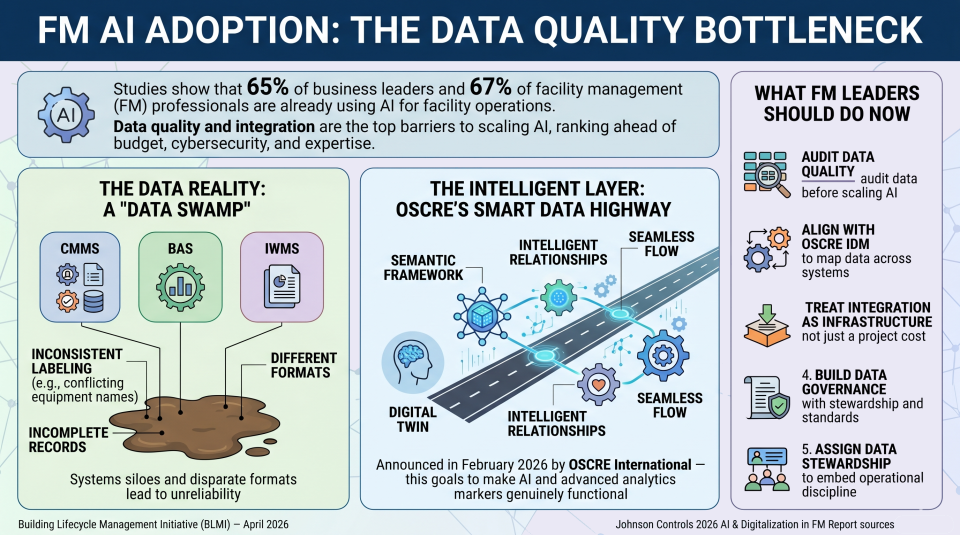
But the same survey reveals a critical friction point: when leaders were asked what most limits their ability to scale AI, data quality and integration ranked first - ahead of budget constraints, cybersecurity concerns, and expertise gaps. The tools are available. The will is present. What is missing is the connective tissue.
What 1,020 Leaders Are Saying
Johnson Controls surveyed 760 U.S. business leaders and 260 FM professionals for its 2026 report, producing one of the larger practitioner datasets on AI adoption in facilities to date. The findings are unambiguous about where the sector stands and what is holding it back.
Forty-seven percent of FM respondents plan to deploy predictive maintenance AI within the next twelve months. Yet one in three business leaders identified ease of integration as the single most desired improvement in their workplace management systems. That tension between deployment ambition and integration readiness defines the current moment.
Budget ranked lower as a barrier than data quality. When cost is not the primary obstacle, the problem is structural. The industry is not short on capital or intent. It is short on the data foundations that AI requires to function reliably.
The Real Bottleneck: Data Quality and Integration
Imagine training a skilled financial analyst to identify patterns in quarterly results - then handing them a filing cabinet of handwritten notes, half in different formats, several missing entirely, and none timestamped consistently. No analyst, however talented, can surface reliable insights from fundamentally inconsistent inputs. Artificial intelligence is no different.
Machine learning models require data that is consistent in structure, complete in coverage, and reliable in origin. Facility operations - spanning Computerized Maintenance Management Systems (CMMS) work orders, Building Automation System (BAS) sensor streams, space management platforms, Integrated Workplace Management Systems (IWMS), and energy metering systems - routinely fail on all three dimensions.
These systems were built independently, by different vendors, for different purposes, at different times. Data fields that should represent the same concept - a piece of equipment, a floor, a maintenance event - are labeled differently across systems. Values are entered inconsistently. Records are incomplete. The result is what practitioners sometimes call a “data swamp”: vast quantities of information that are individually plausible but collectively unusable for predictive analysis without significant remediation work.
The Standards Architecture Response: OSCRE’s Smart Data Highway
In February 2026, OSCRE International announced a significant evolution of its approach to building data standardization. Rather than continuing to develop data definitions in isolation, OSCRE unveiled a “Smart Data Highway” vision - a semantic framework designed to add intelligent layers to its Industry Data Model (IDM), enabling systems to not merely define data fields but comprehend their inherent relationships and broader context.
The initiative is designed to make AI, digital twins, and advanced analytics genuinely functional across the built environment’s fragmented data landscape. OSCRE describes the goal as enabling “intelligent, automated understanding and the seamless flow of information” - language that speaks directly to the integration barrier the Johnson Controls research identifies as the primary AI constraint.
This matters because the data quality problem in FM is not simply a matter of cleaning up existing records. It is a matter of structural alignment across the entire building data lifecycle - from design and construction handoff through decades of operational change. Without a common data model that systems can reference, cleaning data in one system does not prevent it from becoming inconsistent again as it flows into another. The ConnexFM-OSCRE partnership, formalized in January 2025, reflects the same recognition from the FM practitioner community: data management requires coordinated standards development and systematic implementation across platforms.
The CAFM/IWMS Integration Gap
Despite significant investment in Computer-Aided Facility Management (CAFM) and IWMS platforms over the past two decades, integration between these systems and emerging AI layers remains one of FM’s most persistent operational challenges. These platforms remain siloed in most operational environments, with significant manual coordination required to move data between them.
The consequence is that even organizations with modern FM platforms often cannot present AI systems with the unified, consistent data feeds those systems require. Predictive maintenance models need clean historical work order records, real-time equipment sensor data, and asset specifications - typically resident in three separate systems with three separate data models. Research finds that more than two-thirds of FM workers spend significant time on manual coordination across tools rather than higher-value analytical work - a ratio AI is supposed to invert, but cannot when data integration is absent.
As AI capabilities in the CAFM and IWMS space mature, industry observers anticipate convergence toward unified platform environments. But that convergence is years away for most portfolios. FM organizations face a choice: invest in data integration infrastructure now, or continue deploying AI tools that underperform because the data they depend on is not ready.
What FM Leaders Should Do Now
The path forward is not to wait for platforms to converge or standards to achieve universal adoption. It is to begin building data governance disciplines now, while those standards and platforms mature.
- Audit data quality before selecting or expanding AI tools. Understanding where data is inconsistent, incomplete, or siloed is a prerequisite for meaningful AI deployment planning.
- Align data architecture with the OSCRE Industry Data Model. The IDM provides a governance-grade framework for mapping FM data across systems - organizations that align with it now will benefit as AI tools increasingly depend on it.
- Treat integration as an infrastructure investment, not a project cost. The tendency to treat data integration as a one-time implementation expense rather than an ongoing operational capability is one of the primary reasons integration debt accumulates.
- Build data governance into FM operations. Assign data stewardship responsibilities, establish data quality standards for system inputs, and create review cycles. Data quality is not an IT problem - it is an operational discipline.
Key Takeaways
- AI adoption in FM is real and accelerating - 65–67% of leaders are already using it for facility operations.
- Data quality and integration is the #1 barrier to scaling AI in FM, outranking budget constraints, cybersecurity concerns, and expertise gaps.
- The problem is structural: fragmented systems, inconsistent data models, and absent governance - not a lack of technology or intent.
- OSCRE’s Smart Data Highway initiative (February 2026) provides the standards architecture the built environment needs for AI to function reliably at scale.
- FM leaders should audit data foundations and align with the OSCRE Industry Data Model before expanding AI tool deployments.
Sources
- Johnson Controls. (2026). 2026 AI & Digitalization in FM Report. Johnson Controls International.
- OSCRE International. (2026, February). OSCRE unveils vision for a Smart Data Highway. PRWeb.
- ConnexFM & OSCRE International. (2025, January). ConnexFM and OSCRE International partner on managed services agreement. PR Newswire.
- REMI Network. (2026). Five AI insights for FMs in 2026. reminetwork.com.
- eFACiLiTY / Sierra ODC. (2025). AI in Facility Management enters the GenAI era. efacility.in.
- Facilities Dive. (2026). Coverage of AI adoption and cybersecurity in facilities management. facilitiesdive.com.
- Building Lifecycle Management Initiative (BLMI). (2026). FM AI Adoption Series. blmi.org.
