Model Rating Criteria
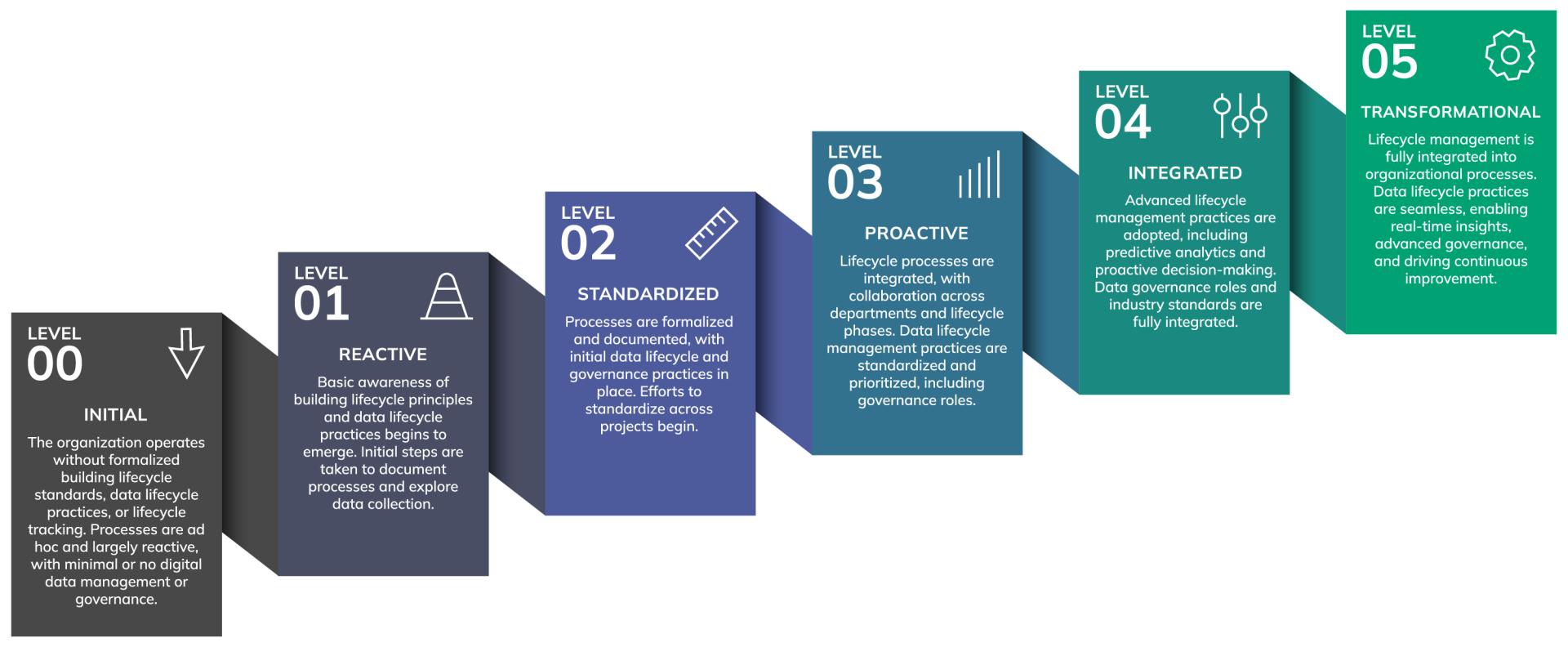
The Building Lifecycle Management (BLM) Maturity Model provides a structured approach for organizations to evaluate their lifecycle management capabilities. By assessing their position on a prescribed scale, stakeholders can identify gaps, prioritize improvements, and establish a roadmap for advancing toward fully optimized lifecycle management practices. Each level of the model reflects increasing sophistication in data integration, process efficiency, and strategic decision-making.
Maturity Levels and Criteria
Level 0: Initial (No Formalized Practices or Standards)
-
Definition: The organization operates without formalized building lifecycle standards, data lifecycle practices, or lifecycle tracking. Processes are ad hoc and largely reactive, with minimal or no digital data management or governance.
-
Characteristics: No centralized data management; manual and disconnected processes; limited awareness of lifecycle, data quality, and data management concepts; no performance tracking, reporting, or data stewardship.
Level 1: Reactive (Basic Awareness and Initial Steps)
-
Definition: Basic awareness of building lifecycle principles and data lifecycle practices begins to emerge. Initial steps are taken to document processes and explore data collection.
-
Characteristics: Some documentation of asset inventories and maintenance processes; initial adoption of digital tools for isolated tasks; awareness of data quality issues begins but no formalized data governance practices; no integration between lifecycle phases; no assignment of data steward roles.
Level 2: Standardized (Documented Processes and Basic Data Management)
-
Definition: Processes are formalized and documented, with initial data lifecycle and governance practices in place. Efforts to standardize across projects begin.
-
Characteristics: Standard operating procedures (SOPs) for key lifecycle activities; use of basic Computerized Maintenance Management Systems (CMMS) or Building Information Modeling (BIM) tools; initial efforts to ensure data quality; minimal coordination between lifecycle phases; initial assignment of data steward roles.
Level 3: Proactive (Integrated Processes and Lifecycle Collaboration)
-
Definition: Lifecycle processes are integrated, with collaboration across departments and lifecycle phases. Data lifecycle management practices are standardized and prioritized, including governance roles.
-
Characteristics: Centralized data repository implemented; BIM used across design, construction, and operational phases; data silos are minimized, and stakeholders collaborate regularly; performance metrics actively tracked and reported; data quality checks are embedded in processes, supported by assigned data stewards and custodians.
Level 4: Integrated (Predictive Capabilities and Advanced Standardization)
-
Definition: Advanced lifecycle management practices are adopted, including predictive analytics and proactive decision-making. Data governance roles and industry standards are fully integrated.
-
Characteristics: Predictive maintenance programs fully implemented; advanced analytics drive decision-making; lifecycle cost analysis is used for all major decisions; data governance includes routine audits, clear stewardship assignments, and protocols for data custodianship; performance metrics align with organizational goals and industry benchmarks.
Level 5: Transformational (Fully Integrated, Data-Driven, and Sustainable)
-
Definition: Lifecycle management is fully integrated into all organizational processes. Data lifecycle practices are seamless, enabling real-time insights, advanced governance, and driving continuous improvement through industry-leading practices.
-
Characteristics: Seamless data flow across all lifecycle stages using advanced technologies like digital twins; real-time tracking and automated reporting of all performance metrics; proactive sustainability and decarbonization strategies embedded in lifecycle planning; fully aligned with recognized standards; comprehensive data governance framework ensures data quality and compliance.
Maturity Model References
Summary
Progressing through the BLM Maturity Model defines a clear path from unstructured and reactive practices (Level 0) to fully integrated, predictive, and sustainable lifecycle management (Level 5). Organizations that begin with disconnected and manual processes can systematically advance toward a state where data-driven decision-making, automation, and cross-disciplinary collaboration optimize building performance, efficiency, and sustainability. By assessing their current level and adopting structured improvements, organizations can systematically enhance their lifecycle management capabilities, driving long-term value and operational resilience.
